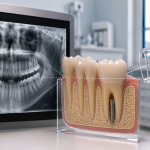

Taking a look inside the mouth requires more than just a glance. When a dentist in Nobleton needs to see what is happening under the gums, they use X-rays. However, a standard X-ray picture is flat, like a photo. It can be hard to tell if a hidden object is closer to the lips or closer to the tongue. To solve this, professionals use a special trick called the SLOB rule. This method helps find the exact location of roots, hidden infections, or teeth that have not grown in yet.
What Does SLOB Stand For?
The name might sound funny, but it is actually a simple guide for reading X-ray images. It stands for Same Lingual, Opposite Buccal.
- Same Lingual: If a hidden object moves in the same direction as the X-ray camera, it sits on the “lingual” side, which is the side near the tongue.
- Opposite Buccal: If the object moves in the opposite direction of the camera, it sits on the “buccal” side, which is the side near the cheek or lips.
By taking two different pictures from two different angles, a professional can figure out the depth of an object that a flat image cannot show.
Why Is This Rule Important?
Finding the exact spot of a problem is key to providing gentle care. For example, if someone is looking for composite fillings near you, a professional might use this rule to check how deep a cavity goes or where a previous filling sits. It ensures that the work is done in the right spot without affecting healthy parts of the tooth.
Using the SLOB Rule for Locating Impacted Teeth
An impacted tooth is stuck under the gums and cannot grow in correctly. The SLOB rule for locating impacted teeth is a vital tool for planning how to help that tooth.
- Planning Surgery: Knowing if a tooth is toward the front or back of the jaw helps the expert decide where to make a small opening.
- Safety: It helps avoid hitting nearby nerves or the roots of healthy teeth.
- Accuracy: It provides a 3D map using 2D images, making the treatment much more predictable.
Without this rule, a professional might have to guess where a hidden tooth is, which could lead to a longer and more difficult visit.
How the Process Works in the Clinic
When you are in the chair, the process is very fast. The expert will take one standard X-ray. Then, they will move the camera slightly to the left or right and take a second one. By comparing where a hidden object “moves” between the two frames, they apply the rule.
- The professional identifies a “reference” point, like a visible tooth root.
- They look at the hidden object next to that root.
- They track which way the object shifted compared to the camera’s movement.
- The final location is confirmed, so the treatment can begin.
Other Uses for This Technique
While finding stuck teeth is a major use, this rule helps in many other areas of dental health:
- Root Canals: It helps find hidden canals that might be tucked behind others.
- Foreign Objects: If a small piece of metal or a broken tool is stuck, this rule finds it quickly.
- Jaw Checks: It can help identify the location of small growths or bone issues.
This clever bit of geometry allows for high-quality care without always needing expensive 3D scans, which saves the patient time and money.
The Value of Advanced Planning
A dental clinic near you uses these methods to ensure every procedure is safe. Whether you need a simple fix or a more complex plan, having an expert who understands these rules makes a big difference. It shows a commitment to detail and a desire to make every visit as smooth as possible. When the professional knows exactly where a problem is, they can fix it faster and with less discomfort for the person in the chair.
Modern Tools, Personalized Care
Expertise and technology go hand in hand to protect your oral health. At Nobleton Dental Smiles, the focus is on using every tool available to provide accurate and gentle treatments. Every smile is unique, and the team works hard to understand the hidden details of your dental structure. Experience care that is planned with precision and delivered with a kind touch.
Contact Nobleton Dental Smiles today to schedule your next exam.
Frequently Asked Questions
Does the SLOB rule require special X-ray machines?
No, this technique works with standard X-ray equipment found in most clinics.
Is it painful to have these X-rays taken?
Taking these images is a completely painless process that only takes a few extra seconds.
Who invented the SLOB rule?
A man named Charles Clark described this method over a hundred years ago to help read dental images better.
Can this rule find a hidden cavity between teeth?
Yes, it helps determine if a cavity is closer to the tongue or the cheek side of the tooth.